
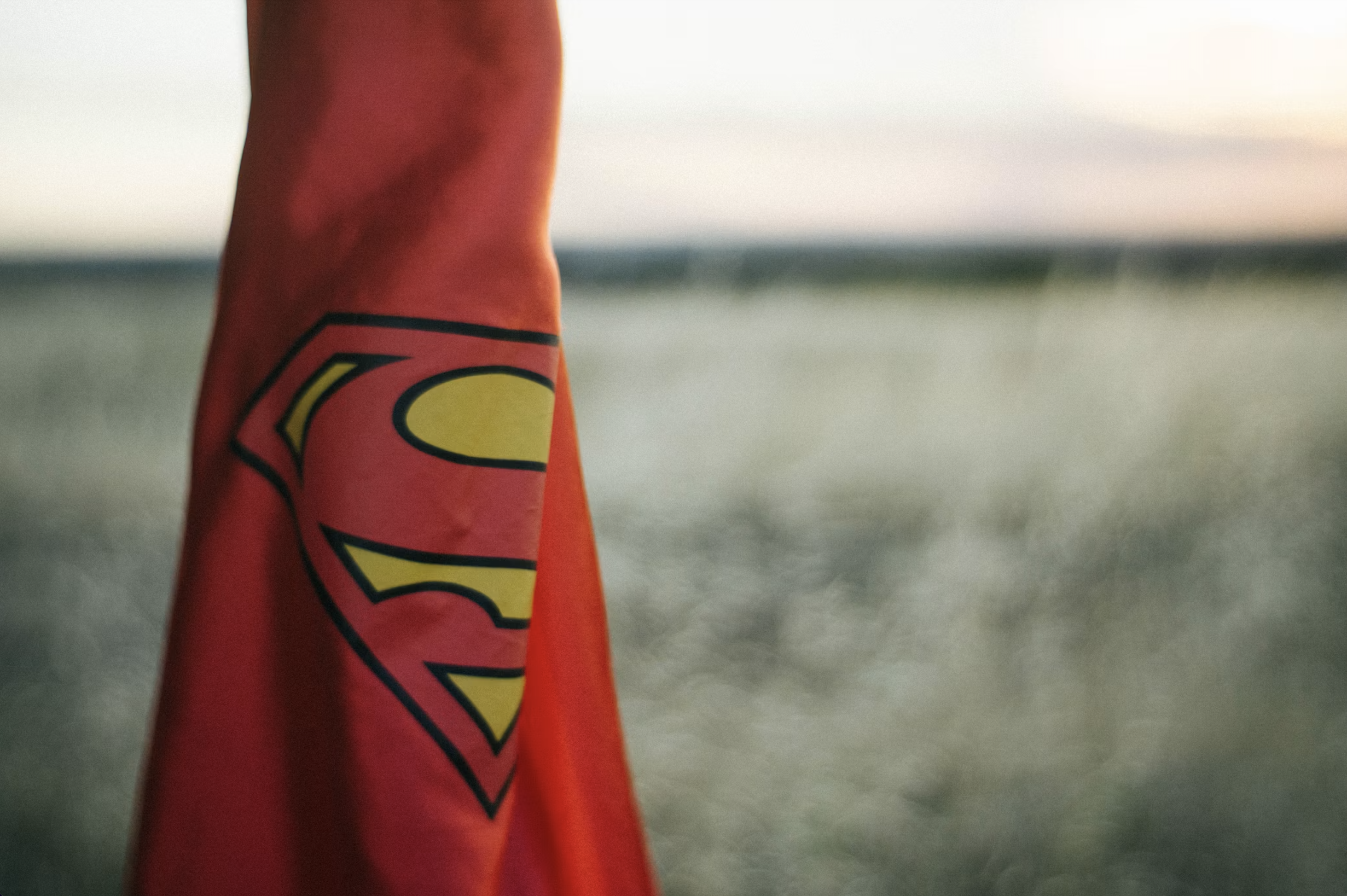
I Killed Superman: A Five-Year-Old’s Guide to Forgiveness
by Nodia Rogers
Today I stood in the African American History Museum overwhelmed with the complexities of the human experience. My feet were heavy on the floor as I watched, listened, and grappled with the history of a people I have never met but whose pain and suffering made way for each opportunity I had in life. I read phrases like “this is the history they didn’t teach you” and climbed each floor with the resilience of my people. Then I came across the Declaration of Independence. It’s important to note that prior to this experience I was in the Nation’s Capital reviewing the same document. It was the same document of history, but I was now experiencing the full story for the first time without excisions. As I grappled with this in real time, out of the corner of my eye I saw a sea of red. Students, probably no older than 14 or 15, entered like a swarm of bees invading a garden. All of them wore a “Make America Great Again” hat carefully positioned atop their head and my only response was to mumble “the audacity” under my breath.
I’ve always been told I look like my mother, and in this moment that couldn’t be more true. My look of disappointment was a motion for a motion match. First came the eyebrows raise, then the tip of my head bent over ever so slightly, and lastly the stare: the type of stare that demands answers. I have only received this look a few times in my life, and at 29-years-old I still remember the very first time she gave me the look.
I was five. It was story time and, like every story time, I climbed onto the sofa with mama expecting to listen to her imagination run wild. Mama had the ability to reimagine the world while also imagining beyond it. She was a storyteller, a preacher, and a healer of hearts through her words. I still remember how she handed that power to me.
She took my head in her hands, her face lit by the dim fire, and she said:
“People listen to stories so that one day they can tell them. Do not take it lightly. Storytelling is a power, a gift, and an act of love: love not just for yourself but for the people you come from, your community, your family.”
She said I had to use my words carefully: that my words were weapons. Each syllable that pierced my lips packed just as much force as a loaded gun.

That day when I told her a story, she didn’t let me curl into her lap. She made me sit tall, she told me to own my words, and to carry their weight because they belonged to me. I told a story way too complex for my young age and to this day I remember more of the ending than I do the rest of the story. In part because my mother, lover of fairytales, superheroes, and things that go “bump” in the night, would not let me live it down.
I spoke of far, far away kingdoms. Princesses, knights in not so shining armor, superheroes, villains, girls in red hoods, and grandmothers. It was clear to my mother that I was drawing from stories I knew and stories she loved. That was until the end when the story, containing multiple fairytales and every marvel character known to a five-year-old in the early 2000’s, ended in death, toil, and truth. In other words, I killed Superman, let the Big Bad Wolf go free, prosecuted the girl in the red hood, and gave Cinderella’s stepmother a 9 to 5.
My mother’s reaction? That look of disappointment. Storytime that day ended in my mother’s tears. This woman really loves Superman, and she couldn’t fathom how her sweet little girl could change the narrative and end it in that way. Although five-year-old me lacked the articulation, the story illustrates what life experiences taught me years later:
Our heroes disappoint us.
I won’t go so far as to say they do it on purpose. Superman can’t help being weakened by kryptonite, and kryptonite wasn’t his moral failing. His moral failing was pretending he could not disappoint us in the first place. Disappointing others is in fact part of the human condition. Standing in that Smithsonian, in the wake of my own disappointment, a group of 15 teenagers taught me the toughest lesson: I am disappointed because I care, and I care because I want what my ancestors wanted… to belong. It is this complex tension between belonging and disappointment that left me crying in Union Station unable to be angry with 15 teenagers wearing “Make America Great Again” hats without first being willing to be angry with myself.
The truth is that I am not alone. We have countless examples in our current socio-political climate where we have allowed disappointment to be the end rather than the beginning. We want to belong, and when others exhibit behaviors of beliefs that challenge that ability, we allow our disappointment to bring us away from God, rather than towards him.
Imagine, if God never showed Moses the promised land after his moment of frustration striking the rock? Imagine, if Harriet Tubman stopped building the underground railroad the first time she got lost? Imagine the world we create when we lose the ability to choose love despite the harm we have faced? This is the world I see in countless news headlines. We have lost the ability to love past our disappointment in one another and have forgotten that God has continued to love us all past the many ways we as a people continue to disappoint him.
So, in a mirror-to-mirror image of my mother and while holding all the wisdom of that five-year-old girl that killed Superman, I will leave you with a three step “Come to Jesus” guideline for the moments you find yourself searching for the courage to belong hidden beneath your disappointment:
Fail often and out loud. We often talk about Saint Peter walking on water and forget that he almost drowned.
Love your neighbor, even when they disappoint you by voting for the wrong candidate or denying your identity. Jesus hung out with people who disappointed him all the time and he loved them through it.
The last, and by far the most important, is that we cannot end our interactions with disappointment. We must try to forgive as often as we are forgiven. God found purpose even in the raven. Are we not all more worthy than birds?
Five-year-old me killed Superman, so that 29-year-old me would learn to love past the sea of red because the true beauty of Superman has nothing to do with his cape and everything to do with his heart.