

TIO Public Square
O Horrid Night, the Guns are Fiercely Blazing
by Robert P. Sellers
During this happy season, as people of many religions have anticipated observing their special holy days and holiday traditions, it is horrific that for some people, joy and laughter, reverence and contemplation, nostalgia and hope were violently replaced by fear and crying.
Students, anticipating the Christmas holidays, had perhaps eased the tension of their final exams by attending concerts and chapel services commemorating the birth of Jesus; Jewish families and individuals, gathered to celebrate the miracle of Hanukkah, were enjoying a festive day on the beach with friends and fellow believers. They, along with good people of many other faiths who heard the terrible news, had their celebrations and holiday plans abruptly interrupted.
Some families, in truth, will never again associate this time of year with unbridled joy, for suddenly there will be “empty chairs at empty tables.” In the words of the poignant lyric from Les Misérables: “There’s a grief that can’t be spoken. There’s a pain goes on and on. Empty chairs at empty tables. Now my friends are dead and gone.”
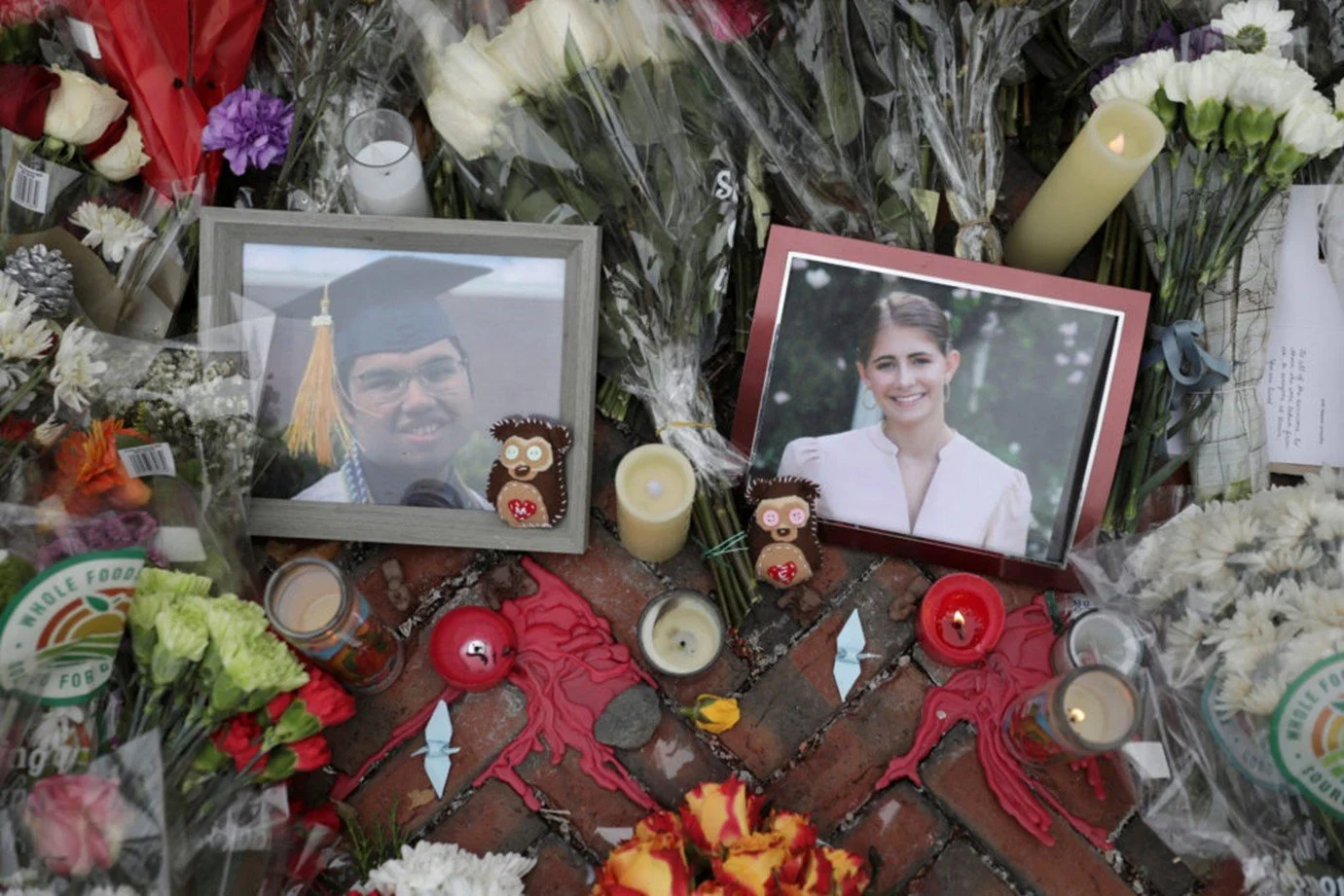
Figure 1 Photos of the two victims Mukhammad Aziz Umurzokov and Ella Cook rest among flowers and candles, following a shooting at Brown University in Providence, Rhode Island, Dec. 17, 2025. Photo by Taylor Coester/ Reuters.
This stark and ugly reality broke the silence in Providence, Rhode Island, on December 13, 2025. It was then that a lone gunman walked into the Barus & Holley School of Engineering building on the second day of fall exams and shot and killed 2 and injured 9 others gathered for a review session of topics for an economics final exam.
Ella Cook, known for her “brave, bold and kind heart,” was a sophomore, the vice president of the Brown University chapter of College Republicans and an active member of her church in Birmingham, Alabama. MukhammadAziz Umurzokov, described as “kind, funny, smart and a role model with big dreams,” was a freshman with dual citizenship in the United States and Uzbekistan who had a reputation for always being willing to help others in need [“Who were the students killed at Brown University. Cook was interested in French and Francophone history and culture while Umurzokov was hoping to become a neurosurgeon. Responding to the tragedy, Brown University president Christina Paxson said: "These were two young people whose amazing promise was extinguished too soon. Both were brilliant and beloved – as members of our campus community, but even more by their friends and families” [Leah Sarnoff and Meredith Deliso, “’Both were brilliant and beloved’: Brown University students identified as victims in campus shooting.”
On December 14 at Bondi Beach in Sydney, Australia, a father and son opened automatic rifle fire onto a crowd of Jews attending a ceremony marking the beginning of Hanukkah. Fifteen people were killed – including a Holocaust survivor and a ten-year-old girl – while 42 others were wounded and rushed to local hospitals. Among the dead were Rabbi Eli Schlanger, a British clergyman who helped plan the event at the park, as well as Rabbi Yaakov Levitan, well-known for organizing special Jewish observances around Sydney. Both men were friendly, popular leaders. This act of antisemitism was the worst mass shooting in Australia since the 1996 Port Arthur carnage.
These two fatal gun attacks, carried out within just a few hours of one another on opposite sides of the globe, traumatized the joy of Christmas preparations and marred the wonder of a Hanukkah remembrance. More than that, these acts of terror forever altered the lives of their victims, loved ones and friends.
Set in this context, it is unimaginable that one of our beloved holiday classics, 1983’s A Christmas Story, tells of Ralphie Parker, a boy in 1940 who longs to find under the Christmas tree an “official Red Ryder, carbine action, 200-shot, range model air rifle, with a compass in the stock.” The successful comedy made BB guns a favorite gift for many Christmases to come and taught a generation of youngsters that guns are fun. The movie has been aired, marathon-style, on TNT since 1997 and on TBS since 2004. Remarkably, “in 2012, it was selected for preservation in the United States National Film Registry by the Library of Congress for being ‘culturally, historically, or aesthetically significant.’”
But while a movie celebrating toy guns may seem incongruous in today’s gun-crazed nation, at least the story was fanciful and funny. Not so with another favorite “Christmas movie” – 1988’s Die Hard. The violent story concerns a terrorist takeover of a Los Angeles skyscraper on Christmas Eve, and the actions of police detective John McClane to eliminate the threat and kill all the terrorists, including the leader, Hans Gruber: “Yippee Ki Yay.” Beginning with friendship and laughter, but turning to shock and murder, the movie has many cringe-worthy moments – where walking on broken glass with bare feet is simply one of the least bothersome. This movie is neither fanciful nor funny, yet it too is a classic, and because the story line takes place at Christmastime, it is judged by many to be a holiday film. But it doesn’t involve a nonviolent resolution, but reinforces the notion that violent retribution is the best – and maybe the only – solution to threatening situations.
America has a long history with guns. But BB guns aside, we do not have a problem with Revolutionary War flintlock muskets, Colt single-action pistols or Winchester rifles of the Old West, or even Prohibition Era tommy guns. Our problem is now 9mm pistols with high-capacity magazines, like the one used at Brown University, or rapid-fire shotguns like those used at Bondi Beach, Australia. Americans’ current gun obsession is with semi-automatic rifles and pistols, the kinds used in the majority of America’s mass killings.

Figure 2: Rep. Thomas Massie, R-Ky., posted a photo of his family posing with guns on his Twitter account. NBC News. 2021.
In November 2021, a 15-year-old boy in Oxford, Michigan, allegedly opened fire on his fellow students and killed four and wounded others. Within days, in early December, Rep. Thomas Massie, R-Ky., posted his family’s holiday message on social media, featuring a photograph of himself, his wife, and each of his five children, posing in front of the Christmas tree and each holding rifles. Not to be outdone, Rep. Lauren Boebert, R-Colo., posted a similar photo of herself and her four young boys, each child grasping a long gun.
In the almost 30 years since the Port Arthur shooting, Australia was seen as a world leader in gun control, with its strict gun laws and few mass shootings. But the growth of gun sales has Australian lawmakers concerned. There are now 3.1 million registered guns owned by 27.4 million Australians. But compare that to the United States, where we have had 135 mass shootings since 1996, with some 500 million guns owned by 343 million Americans.
After the Bondi Beach shooting, Australian Prime Minister Anthony Albanese promised to tighten the country’s already strict gun laws. And, after the Brown University shooting, President Trump didn’t tighten gun laws, but instead tightened immigration laws and suspended the green card lottery program. He also praised Brown University and not the murdered students.
He said: “I want to just pay my respects to the people, unfortunately two are no longer with us, Brown University, nine injured and two are looking down on us right now from Heaven. Brown University, great school, really one of the greatest schools anywhere in the world. Things can happen.”
As we move into the New Year, maybe around the public square we might be bold enough to initiate conversations about our gun fascination and mass shooting addiction. If we decided not to talk about who is dating whom in Hollywood or which Division 1 sports team is doing well, could we engage this difficult but critical topic which might help to heal our nation?
One of the most beautiful sacred songs of the Christmas season is “O Holy Night.” Originally titled Cantique de Noël, the lyrics are based on a French-language poem written in 1847 and translated into its English version by John Sullivan Dwight. The opening lines are “O Holy Night, the stars are brightly shining.”
Perhaps it is not inconceivable to rewrite those meaningful lyrics to produce a dirge: “O horrid night, the guns are fiercely blazing.”
Will it ever end? If not now, when?